Stablecoin And The Future Of Trade Finance: Opportunities To Reinvent Cross-Border Payments In Vietnam


In the context of Vietnam accelerating its strategy to develop an international financial center and promote digital transformation in the finance–banking sector, emerging technologies such as blockchain and stablecoins are increasingly being viewed not only from an experimental perspective, but also as potential components of future financial infrastructure.
In particular, within the field of trade finance, stablecoins are emerging as a solution capable of restructuring cross-border payment processes toward a model that is more transparent, efficient, and programmable.
Stablecoins and the Potential to Redefine Trade Payments
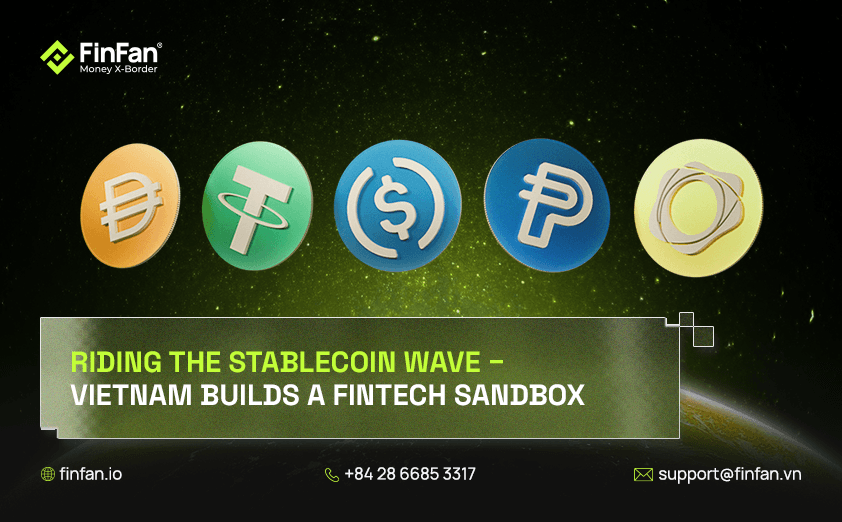
Stablecoins, or digital assets USDT, enable near real-time transactions while reducing reliance on traditional intermediary layers.
Beyond improvements in speed and cost, stablecoins also introduce the programmability of cash flows, allowing payment conditions to be embedded directly into each transaction. Accordingly, disbursements can be executed automatically upon fulfillment of contractual obligations, payments can be aligned with delivery milestones, and reconciliation as well as data recording can be integrated and updated in real time.
These characteristics provide a critical foundation for transforming trade finance from a traditional manual processing model to an automated operating model based on API connectivity and modern digital systems.
From Legal “Grey Areas” to Transparent Global Regulatory Frameworks
One of the major barriers to stablecoin adoption in its early stages has been legal uncertainty. For many years, stablecoins were considered to exist in a “grey area,” making financial institutions more cautious in their implementation.
However, global trends have recently shifted in a more positive direction. In Singapore, the Monetary Authority of Singapore (MAS) has introduced a regulatory sandbox, allowing businesses to test innovative financial solutions within an appropriate legal framework.
At the same time, MAS issued a dedicated regulatory framework for stablecoins in 2023. Under this framework, issuers are required to meet strict standards, including maintaining reserve assets, conducting independent audits, and adhering to clear and transparent issuance and redemption processes.
According to MAS, stablecoins that meet these standards will be recognized as “MAS-regulated stablecoins,” thereby establishing a clear legal foundation for real-world deployment. This marks an important step forward, demonstrating that stablecoins are llikely becoming part of a regulated financial system.
X-Border – Infrastructure Connecting Stablecoins with Vietnam’s Cross-Border Payment Systems
While stablecoins effectively address global transfer challenges, their practical implementation still faces a key issue: integration with domestic financial systems. This gap creates the need for an intermediary infrastructure layer capable of bridging global liquidity with local financial ecosystems.
In response, X-Border has been developed as a cross-border financial infrastructure designed to orchestrate global fund flows across multiple payment channels. The system enables simultaneous connectivity with traditional banking networks (such as SWIFT), domestic payment systems, and blockchain networks.
As a result, X-Border forms a unified infrastructure layer that supports the full lifecycle of international payments, including collection, transfer, conversion, and settlement. A key differentiator of X-Border lies in its multi-rail and API-first architecture, allowing businesses and financial institutions to integrate directly into their existing systems without the need to build complex infrastructure.
This enables enterprises to receive payments from multiple countries, process multi-currency transactions, and automatically convert and settle funds into local currency such as VND in a fast and compliant manner.
With a compliance-first design, X-Border integrates the most stringent regulatory standards, including AML, CFT, and KYT, along with sanction screening and real-time transaction monitoring. It also ensures full adherence to the Travel Rule in line with FATF recommendations. This robust compliance foundation enables us to operate securely within regulatory sandboxes and meet the expectations of supervisory authorities. —--
About X-Border
X-Border is a financial infrastructure layer connecting Vietnam to the global economy. Built to support compliant, real-time, and multi-currency settlement, X-Border enables enterprises, fintechs, and global partners to access Vietnam’s financial system through a unified, API-based settlement platform. From stablecoin-powered flows to fiat settlement, X-Border simplifies cross-border transactions into a seamless and scalable experience.
Contact Us
To explore partnership opportunities or learn more about X-Border’s settlement infrastructure, please contact us at: 📩 Email: contact@x-border.com | 🌐 Website: https://xborder.io/