Top 5 of Global Fintech Megatrends in 2024 – Which can be Strongly Developed in Vietnam?

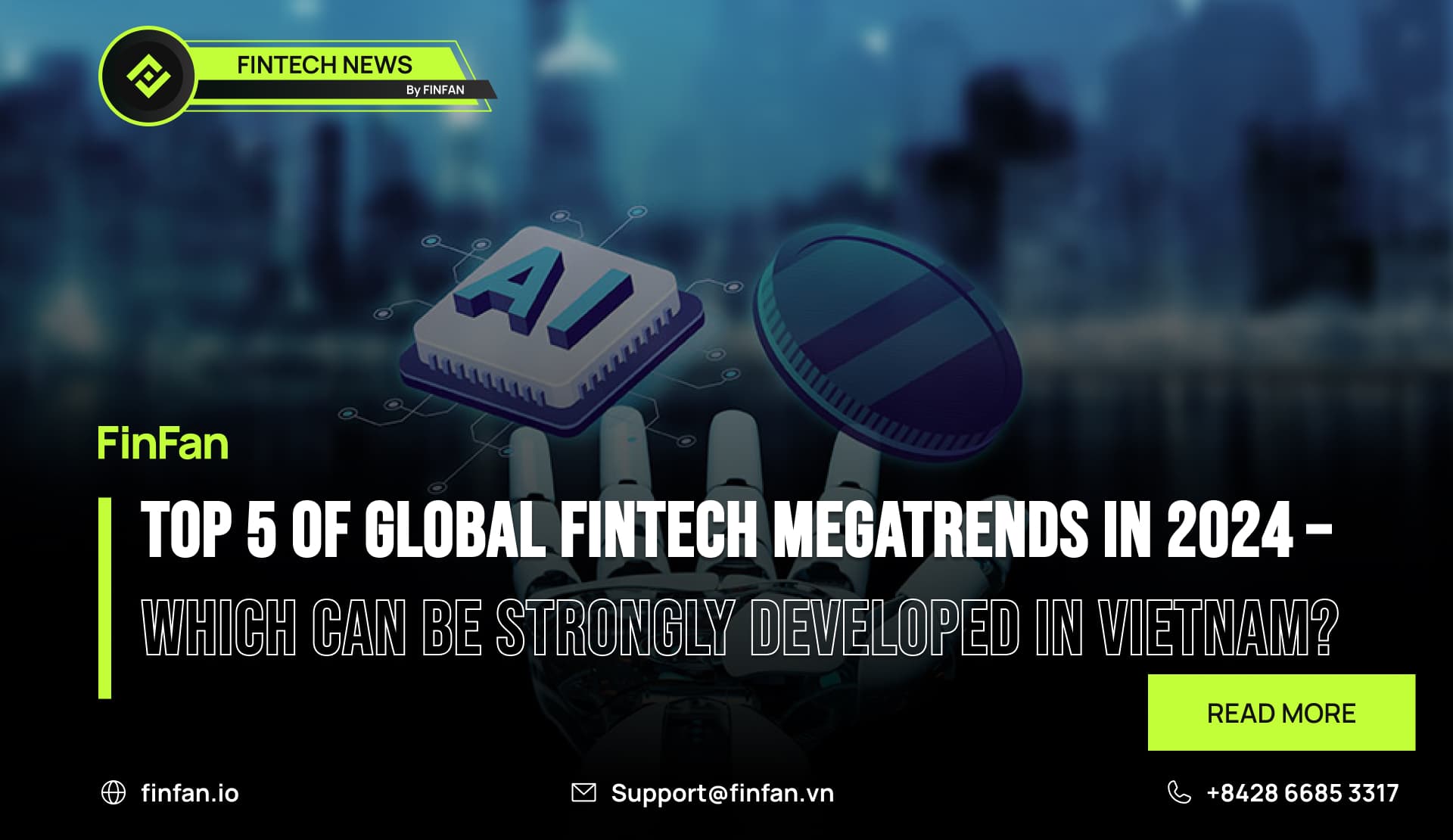
According to an analysis published by Fintech News Switzerland, several major trends are shaping the global fintech industry. These include sustainable finance, generative AI integration, B2B fintech infrastructure, tokenization of assets, and next-generation compliance technologies.@finfanio Top 5 Global Fintech Megatrends in 2024 #fintech #trends #megatrend #finfan #finfanio ♬ พี่ชอบหนูที่สุดเลย (I Like You The Most) Feat.VARINZ - Speed Up Version - PONCHET
Among these developments, which fintech trends have the greatest potential to grow in Vietnam? In this article, FinFan explores several global developments and discusses how they may relate to Vietnam’s evolving financial technology landscape.
Top 5 of Global Fintech Megatrends in 2024
The First Trend of Fintech has been Really Popular Recent Years: Sustainable or Green Finance
Sustainable finance has become one of the most widely discussed topics in the global financial sector. Financial institutions are increasingly evaluating the environmental impact of their operations and investments.
While digital finance was once expected to significantly reduce resource consumption, new technological developments have also introduced environmental considerations. For example, cryptocurrency mining requires substantial computing power and electricity.
International initiatives such as the Net‑Zero Banking Alliance have been formed, bringing together financial institutions committed to reducing emissions associated with lending and investment activities.
At the same time, new sectors such as the voluntary carbon market (VCM) are emerging. These markets allow companies to purchase carbon credits to offset greenhouse gas emissions. According to industry estimates, the voluntary carbon market was valued at approximately US$2 billion in 2021 and could expand significantly in the coming decade. Technological solutions that improve transparency, monitoring, and reporting of environmental data are expected to play an increasingly important role in this sector.
Generative AI and Automation in Financial Services
Artificial intelligence and automation technologies are rapidly transforming many industries, including finance.
AI-based systems are now widely used in areas such as:
- fraud detection
- customer service automation
- credit risk analysis
- transaction monitoring Advances in machine learning have also enabled the development of automated trading systems capable of processing large volumes of financial market data.
It is important to distinguish between algorithmic trading systems, which operate in financial markets, and digital payment infrastructure, which supports domestic and cross-border money transfers. These two areas serve different purposes and are typically regulated under different licensing and compliance frameworks.
Nevertheless, the technological capabilities involved such as large-scale data processing, automation, and predictive analytics can contribute broadly to the digital transformation of financial services.
Vietnam has also seen increasing activity in the AI sector across industries. With a growing pool of technology engineers and developers, the country has demonstrated strong capabilities in software engineering and AI development.
While automated trading technologies primarily apply to financial markets, expertise in AI systems development may also support improvements in financial infrastructure, including payment processing, fraud monitoring, and operational automation.
However, financial technology innovation must operate within existing regulatory frameworks. Areas such as foreign exchange management, cross-border capital flows, and leveraged financial trading are regulated by the State Bank of Vietnam and other relevant authorities. As a result, fintech companies must ensure that technological innovation aligns with applicable financial regulations.
The Third One is Integrating Multi-platform Financial APIs and B2B Fintech.
Another major trend shaping fintech globally is the expansion of financial APIs and B2B fintech services.
Financial APIs allow different digital systems to connect and exchange data securely. Through APIs, companies can integrate services such as payments, account information, and transaction processing into their existing platforms.
For businesses, these integrations can streamline financial management across departments. For example:
- finance teams may manage international payments
- marketing teams may process advertising budgets
- HR departments may handle payroll and recruitment expenses By integrating multiple financial tools into a unified system, businesses can improve operational efficiency and financial visibility.
Fintech companies worldwide are increasingly developing API-based services that allow businesses to embed financial capabilities directly into their platforms. This approach supports scalability and enables companies to deploy new financial features without building complex infrastructure from scratch.
Next is Tokenization, Alternative Assets among Top Wealthtech Trends
Asset tokenization has become an important topic within wealthtech and digital finance discussions.
Tokenization refers to the process of representing ownership of real-world or financial assets using digital tokens on blockchain infrastructure. Potential use cases may include assets such as real estate, funds, or other investment instruments.
Several global financial institutions, including JPMorgan Chase and ABN AMRO, have explored blockchain infrastructure for tokenized financial assets.
However, regulatory approaches to digital assets and tokenization vary significantly across jurisdictions. In Vietnam, the legal framework governing cryptocurrencies, tokenized securities, and digital financial assets remains under development.
As a result, the adoption of tokenization-related financial products in Vietnam would depend on future regulatory guidance and market infrastructure development.
Next-Generation Compliance and RegTech
Compliance remains one of the most important aspects of the financial industry. Financial institutions must comply with regulatory requirements related to:
- Know Your Customer (KYC)
- Know Your Business (KYB)
- Anti-Money Laundering (AML)
- transaction monitoring Industry organizations such as EY estimate that the global cost associated with money laundering and financial crime may reach trillions of dollars annually.
As financial crime techniques become more sophisticated, fintech companies are developing advanced compliance technologies that incorporate artificial intelligence, biometrics, and data analytics to strengthen monitoring systems.
These solutions aim to support continuous identity verification, improve fraud detection, and enhance regulatory compliance across financial platforms.
FinTech Trends with Potential in Vietnam
Among the trends discussed above, FinFan identifies three areas that currently show strong potential for development in Vietnam:
- AI and automation in financial services
- financial APIs and B2B fintech infrastructure
- compliance and regtech technologies Other trends, such as green finance and asset tokenization, are also being discussed but may require further development in regulatory frameworks, market education, and infrastructure.
Strengthening Compliance and Fraud Prevention
Financial fraud and cyber-enabled scams have become a global challenge across digital platforms.
These schemes may involve phishing attacks, impersonation scams, or fraudulent investment opportunities that exploit gaps in digital literacy or identity verification systems. To address these risks, financial institutions and fintech companies are increasingly investing in technologies that enhance identity verification, transaction monitoring, and fraud detection.
Improving public awareness and strengthening compliance systems will remain important steps in building a safer digital financial ecosystem.
Conclusion Regarding Global Megatrends of Fintech and these applications in Vietnam
Global fintech trends continue to evolve rapidly, driven by technological innovation and changing regulatory landscapes.
While certain developments such as AI integration, financial APIs, and compliance technologies are already gaining momentum in Vietnam, other trends like sustainable finance and asset tokenization may develop more gradually as regulatory frameworks and market infrastructure evolve.
By continuing to invest in technology development and regulatory readiness, Vietnam has the potential to further strengthen its fintech ecosystem and support innovation in financial services.
Reference:
-
Boston Consulting Group. (2022). Relevance of on-chain asset tokenization in capital markets. Boston Consulting Group. https://www.bcg.com/publications/2022/relevance-of-on-chain-asset-tokenization
-
Cambridge Centre for Alternative Finance. (2023). Cambridge Bitcoin electricity consumption index. University of Cambridge. https://ccaf.io/cbeci
-
EY. (2023). Global financial crime and fraud survey. Ernst & Young Global Limited. https://www.ey.com
-
Financial Action Task Force. (2023). International standards on combating money laundering and the financing of terrorism. https://www.fatf-gafi.org
-
Fintech News Switzerland. (2024). Global fintech trends shaping financial services. https://fintechnews.ch
-
International Monetary Fund. (2023). Artificial intelligence and the future of financial services. https://www.imf.org
-
McKinsey & Company. (2022). A blueprint for scaling voluntary carbon markets. McKinsey Sustainability. https://www.mckinsey.com
-
Net-Zero Banking Alliance. (2023). About the Net-Zero Banking Alliance. United Nations Environment Programme Finance Initiative. https://www.unepfi.org/net-zero-banking/
-
State Bank of Vietnam. (2023). Regulatory framework for payment systems and foreign exchange management. https://www.sbv.gov.vn
-
Alex de Vries. (2022). Bitcoin’s growing energy footprint. Joule, 6(3), 498–502. https://doi.org/10.1016/j.joule.2022.02.006
-
World Bank. (2023). Artificial intelligence in financial services and development. https://www.worldbank.org
-
World Economic Forum. (2023). The future of financial services. https://www.weforum.org
About FinFan
FinFan is a cross-border embedded financial services company that focuses on mass disbursement, fund collection, card processing, IBAN, and digital APMs solutions, which can provide valuable input and integration on and for the same.
FinFan is already integrated with almost the world's well-known MTOs, PSPs, switch, and core fintech platforms such as Money Gram, Thunes, Qiwi, Remitly, World Remit, Bancore, PaySend, Terrapay, Ria Money Transfer (Euronet), Dlocal, Ripple, TripleA, FoMo Pay, Wings, etc.
For more information, please get in touch with us through:
🌐https://finfan.io
📞(+84) 2866 85 3317
✉ support@finfan.vn
LinkedIn: FinFan